

The pet store products most likely to send a dog to the vet are hard chews like antlers and real bones that fracture teeth, rope toys that unravel into intestinal blockages, retractable leashes that cause neck and tracheal injuries, and prong or aversive collars that bruise the throat. None of this means your dog should not have toys, chews, or a collar. It means the riskiest products tend to look the most normal on the shelf, and the safest pick depends on your dog’s size, age, and chewing style. A few minutes of knowing what to skip prevents most of the injuries we treat.
Empowering you to walk out without lingering questions is the standard we hold ourselves to at Town & Country Animal Hospital in Athens, and that includes helping you sort the safe gear from the gear that lands a dog in our exam room. Our advanced diagnostics in Athens, including in-house X-ray, ultrasound, and surgical capability, let us find a swallowed chew piece, evaluate a cracked tooth, or address a soft-tissue injury when a toy or collar goes wrong. Bring the toy or chew you are unsure about to your next wellness visit and we will look at your dog’s teeth, neck, and mouth for the wear these products leave behind. Urgent care appointments and walk-ins are welcome, so call us then come in and we will take a careful look.
What Matters Most
- Many common pet store products, from rope toys to antlers to retractable leashes, cause the exact injuries we treat every week, and the packaging rarely mentions any of it.
- A hard chew that fractures a tooth usually leads to an extraction, so the thumbnail test (if your nail cannot dent it, it is too hard) is worth doing before anything reaches your dog’s mouth.
- Aversive training tools like prong, choke, and shock collars carry both physical and behavioral risks, while reward-based training is safer and works better over time.
- The right gear depends on your dog’s size, chewing style, and behavior, which is exactly what a preventive care head-to-tail exam is built to sort out.
What Are Pet Store Products Actually Doing to Dogs?
Most gear injuries we see trace back to normal-looking shelf products: hard chews that crack teeth, rope and stuffed toys that break into swallowable pieces, retractable leashes that strain the neck, and aversive collars that press the throat. Some hurt in one moment; others build quietly until the damage is already done.
A split tooth from one determined chomp is the sudden kind. The sneaky kind is a rope toy shedding strands your dog swallows one at a time until a blockage forms, because by the time signs show, the trouble is well underway.
How Can Dog Body Language Tell You Gear Doesn’t Fit?
Dogs tell you whether gear is comfortable long before a sore shows up, mostly through posture, expression, and movement. Watch the moment gear goes on. Lip licking, a stiff or frozen posture, and pinned-back ears are early notes that a collar or harness is bothering your dog.
Those signs are part of canine body language, and other stress signals show up here too: yawning when your dog is not tired, whale eye, backing away, and a tucked tail.
There are also physical signs that gear has been causing trouble for a while. Catch these early and you can fix the fit before it turns into a sore:
- Pawing at the gear: rubbing or scratching at a collar, harness, or chew usually means it does not feel right.
- Coughing or hacking on walks: a sign that pressure is landing on the windpipe.
- Skin changes where gear sits: redness, rubbing, or hair loss under a collar or harness strap.
- Limping after walks: soreness that shows up once the leash comes off.
- Flinching when touched: pulling away where equipment normally rests points to a tender spot.
Why Do Veterinarians Recommend Reward-Based Training?
We recommend reward-based training because it rewards the behavior you want instead of punishing the behavior you don’t, which builds trust, lowers stress, and creates lasting habits without any tool that can hurt the throat, neck, or spine. It teaches, rather than suppresses.
Take leash pulling: a prong collar suppresses the pulling through pain but never touches the stress or excitement driving the dog forward. The reward-based route teaches that a loose leash earns a small treat, so the behavior sticks on its own.
Leash reactivity, that lunging, barking response to another dog across the street, is where this really shows its value, because reward-based work slowly reshapes the emotional response from fear toward calm rather than just suppressing it. One tool that helps is the engage-disengage game, which teaches a dog to notice a trigger calmly and then look back at you. Starting this work early, around the time of a puppy’s first exams, gives good habits the best chance to take hold.
Which Training Devices Should You Avoid?
The training devices to avoid are the ones that rely on pain or pressure to work: prong collars, choke chains, and shock collars. Calling them “training collars” is clever marketing, because the training collars that rely on pain suppress a behavior in the moment without teaching your dog anything of value.
What’s the Problem With Prong Collars and Choke Chains?
Prong collars and choke chains work by tightening around the neck to make pulling uncomfortable. A sudden lunge into a tightening collar is where the risk turns serious, with tracheal damage, neck and spine injury, skin punctures, and pressure on the thyroid gland all landing on delicate structures. These collars are especially risky for dogs who already have tracheal collapse or disc disease, where that force can turn a manageable condition into an emergency.
Are Shock Collars Really That Bad?
Shock collars are often sold under friendlier names like e-collars, but aversive training methods tend to raise a dog’s stress and worsen the exact behaviors they were meant to fix. The contact points can cause burns and skin damage, and a dog can develop a deeper fear of whatever came right before the shock. Aggression can follow when a dog links the pain to a nearby trigger, another dog, a person, or a passing car, rather than to their own behavior.
Why Do Vets Warn About Retractable Leashes?
Retractable leashes are built to extend right when a dog pulls, which rewards the pulling and leaves you with far less control the moment something goes wrong. Because your dog can be fifteen or twenty feet away, you cannot reel them in fast when a squirrel bolts. The thin cord brings its own injuries, including cuts and friction burns to hands, legs, and paws, and a hard lunge from a big dog can snap the cord outright.
What Walking Equipment Do Veterinarians Recommend?
The gear we recommend follows one principle: keep pressure off the throat, match the equipment to your dog’s build, and pair it with a fixed-length leash. Choosing between head halters and harnesses comes down to that same idea, with a front-clip harness redirecting a puller and a head halter giving gentle control to the strongest pullers.
The table below lays out the main options and when each makes sense. If your dog fits more than one row, or you are not sure where they land, that is a good thing to talk through with us.
| Walking gear | Best for | How it works |
| Front-clip harness | Dogs that pull | Redirects forward motion from the chest, no throat pressure |
| Head halter | Strong pullers | Gentle head control, needs a patient introduction |
| Back-clip harness | Easy walkers | Comfortable, keeps all pressure off the throat |
| Martingale collar | Narrow-headed dogs | Prevents backing out without choking when fitted right |
| Flat collar | ID tags, everyday wear | Fine for tags, not for a puller to pull against |
There is no single “best” tool here. Getting it right is less about buying the priciest harness and more about matching the right collar to your dog’s actual body shape and behavior, which we are glad to help you figure out.
Do Standard Leashes and Long Lines Work Better?
A fixed four-to-six-foot leash gives the best balance of freedom and control for everyday walks, and walking nicely on leash is far easier when your dog is not rewarded with more slack every time they pull. For recall practice in open spaces, long line training with a fixed fifteen-to-thirty-foot line is the safer swap for a retractable leash.
Which Toys Are Most Likely to Injure Dogs?
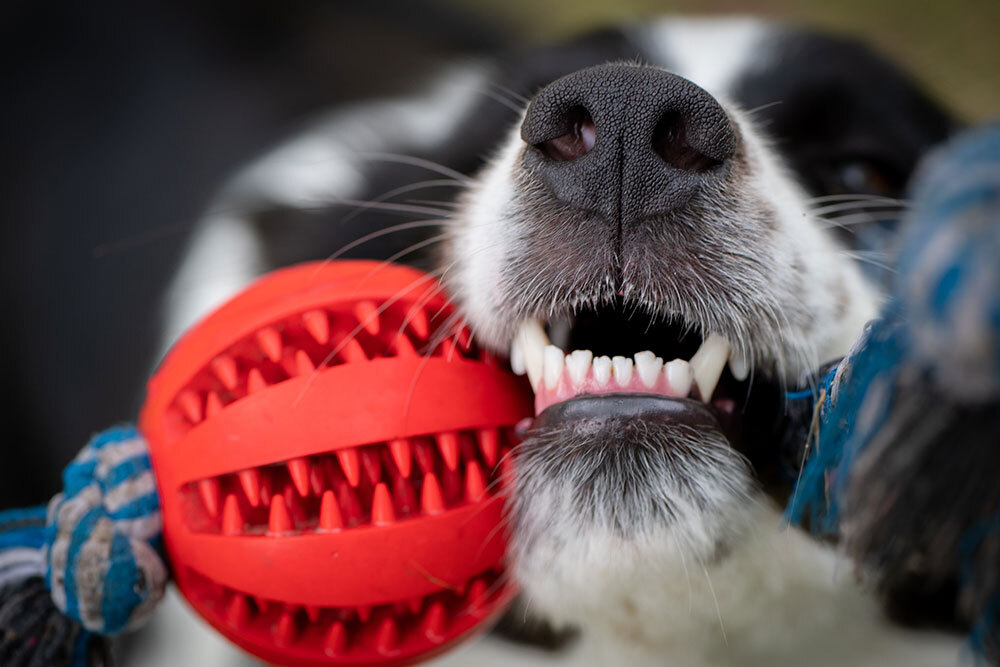
The toys that cause the most trouble are the ones that break into swallowable pieces or are hard enough to crack a tooth. A swallowed piece can range from mild stomach upset all the way to a gastrointestinal obstruction that needs emergency surgery, which is why a toy’s size and durability matter as much as how fun it looks. The riskiest ones include:
- Rope toys: chewed-off strands can bunch into a linear foreign body that saws at the intestine, a real danger for hard chewers.
- Squeaker toys: once the squeaker is exposed, it becomes a choking hazard.
- Undersized balls and toys: anything smaller than your dog’s mouth can be swallowed whole, and even solid ball toys have gotten lodged in the back of the throat.
- Hard plastic toys: rigid enough to fracture teeth in a determined chewer.
- Stuffed toys: swallowed filling can pack together and block the gut.
- Abrasive toys: the felt on tennis balls for dogs acts like sandpaper, wearing enamel down over time.
Most toy emergencies are preventable with a few small habits: replace worn toys before they fragment, supervise a new toy until you know your dog’s chewing style, rotate the bin so nothing gets destroyed out of boredom, and size up so nothing swallowable is ever within reach. When a piece does go down, our in-house X-ray helps us locate it fast, and surgery to remove a swallowed object is available when it cannot pass on its own.
Which Chews and Treats Pose the Biggest Risks?
Chewing itself is healthy, but the dangers of popular dog chews come from products hard enough to crack a tooth or dense enough to lodge in the gut. The tooth that pays the price most often is the large upper chewing tooth called the carnassial, and a fracture that reaches the pulp almost always ends in an extraction. Even without a clean break, years of grinding can wear the tooth down until the pulp is exposed, which can set up a painful tooth root abscess. A handful of chews come up again and again:
- Real bones, raw or cooked: a leading cause of fractured carnassial teeth, because real bones are simply harder than tooth.
- Rawhide: softens into a dense wad that resists digestion, and rawhide can lodge in the esophagus or intestine.
- Antlers and hooves: notorious for slab fractures of the premolars, and antlers and hooves often go unnoticed until a dog starts chewing only on the other side.
- Hard nylon bones: can splinter into sharp points that scratch the gut.
- Any chew worn to a nub: small enough to swallow whole and choke on.
Chew trouble does not always announce itself, so watch for the warning signs of a worn or fractured tooth: a broken or crooked tooth, heavy wear, bleeding gums, heavy drooling or pawing at the face, worse breath, and any change in appetite or vomiting. When a tooth is damaged, dental radiography shows us what is happening below the gumline and we can decide the best course of action together.
What Are the Safer Toy and Chew Alternatives?
The rule for any chew is the thumbnail test: if your thumbnail cannot dent it, it is too hard for your dog’s teeth. The Veterinary Oral Health Council seal points you toward dental chews with proven benefit rather than guesswork. Collagen-based sticks and rawhide alternatives stand in for real rawhide or real bones without the same fracture and blockage risk. Safer chew toys are ones that flex a little but are resistant to breaking into pieces. For toys, the goal is engagement without heavy chewing:
- Food-stuffed rubber toys: channel chewing into something productive that lasts.
- Puzzle feeders: work the brain without grinding on the teeth.
- Snuffle mats: turn a meal into a sniffing hunt, which most dogs love.
- Treat-dispensing toys: sized to the individual dog so nothing is small enough to swallow.
If you want an easy starting point, VOHC-accepted dental chews are stocked in our online pharmacy, so you can skip the guesswork at the pet store shelf.
When Is Destructive Chewing a Medical Problem?
Gear and toys alone rarely fix a true behavior problem, and a sudden change in chewing is worth a second look because it can point to something physical rather than plain mischief. Sudden or new destructive chewing can trace back to several medical causes:
- Pain: some dogs chew hard for relief, including from a sore tooth or an aching joint.
- Cognitive change: older dogs can develop new, restless chewing habits as their thinking shifts.
- Anxiety: a household change, a new schedule, or a move can trigger stress chewing.
- Endocrine or metabolic disease: conditions that shift appetite and energy can change behavior too.
Because of that, a wellness visit to rule out a medical cause is the right first step before treating the chewing as purely behavioral. This is especially true for older dogs, where our expanded care for older dogs screens for the cognitive and metabolic shifts that show up with age. That same wellness visit can catch a treatable cause before you spend months on training that was never going to be enough.
Frequently Asked Questions About Dog Gear Safety
My dog swallowed a piece of a toy. What should I do?
Call us right away, even if your dog seems fine. Small, smooth pieces sometimes pass on their own, but rope strands, stuffing, and hard fragments can lodge in the gut and cause a blockage that turns serious.
Watch for vomiting, a drop in appetite, straining, or a tender belly over the next day or two, and do not wait for those to appear before checking in. Our in-house X-ray helps us see whether the piece is moving through or getting stuck, which decides everything about what comes next.
Are any bones or antlers safe for my dog to chew?
As a rule, if it is hard enough that your thumbnail cannot dent it, it is too hard for your dog’s teeth, and that rules out real bones, antlers, and hooves. These are the products most often behind the fractured teeth we treat. Safer options include VOHC-accepted dental chews, food-stuffed rubber toys, and collagen-based chews that satisfy the urge to gnaw without the fracture risk. When in doubt, bring the chew to a visit and we will tell you whether it is safe for your particular dog.
What kind of collar or harness is best for a dog that pulls?
For most pullers, a front-clip harness is the best starting point, because it redirects your dog’s forward motion from the chest instead of loading the pull onto the throat. Very strong pullers may do better with a head halter, which gives gentle control but needs a patient introduction. A flat collar is fine for holding ID tags but should not be the point your dog pulls against. The right match depends on your dog’s build and behavior, so we are happy to help you choose.
Choosing Gear That Keeps Your Dog Safe and Happy
The gear, toys, and chews you pick shape more than a fun afternoon. Informed choices protect your dog’s health, support the behavior you want, and head off the painful, costly emergencies that so often start with a well-meant purchase off the pet store shelf. The best pick always comes back to your individual dog, their size, their chewing style, and their history, which is exactly the kind of conversation a wellness visit is made for.
If you want personalized recommendations, or you have spotted a worn tooth, a rubbed neck, or a swallowed piece, reach out to our team and we will take a careful look. And if you notice a sudden emergency during our hours, like a swallowed object or a dog in distress, call us right away so we can help fast.



Leave A Comment